Showing posts with label diy. Show all posts

Saturday, February 16, 2013

Bathroom Bathtub Install

We purchased the bathtub from RONA it was a “Corinthia II” made by Advanta by Maax.  As mentioned we wanted a taller tub and needed one that was right-side installation.  We also got the overflow kit and accessories from RONA.  The tub it was replacing was a standard size so this was pretty easy change.

As I mentioned in a previous post we purchased the bathtub from RONA it was a “Corinthia II” made by Advanta by Maax.  In this post I will discuss the installation of the tub.  This tub has raised under structure so if you wanted a right side drain tub, but had the plumbing in for a left it could be accommodated, but I was already set for a right side drain and I wanted to keep it that way.  I did not take any pictures of me setting this up, so I will do my best to describe the process.

As with any floor space I am sure it is crowded in between the joists, and mine was no different, I had a HVAC duct running beside my drain lines.  I also discovered when I was getting to put the drain/overflow kit on that the original P-trap was not properly glue onto the pipe.  I corrected this when I glued the other parts back on. 

The first step with the tub install is the base.  It needs to be level.  I found the instructions a little bit confusing at first as they were talking about laying a mortar bed down of self-levelling material on top of the sub floor.  I pulled out my level and I checked the floor all different ways and I was within acceptable limits for the floor level.  Meaning the bubble was touching the line but not going past.  Now onto the edge support.  The edge of the tub needs to be supported underneath it and calls for a 1x3 ledger.  I would usually like to use a 2x4 as the ledger support and I contemplated it, but when I checked to see if a 2x4 would fit it looked like it would rest too far in and I was not sure if it could take the structural strain at that location.  I marked out where the ledger should go and installed it level as well.

SAM_0377

It was time to hook up the plumbing.  I tried to measure where the center of the drain was and got close.  I measured the ABS pipe and cut it long and then slowly cut it down until it fit.  Once the pipes were the right length I glued them together.  While the glue was still wet I screwed in the overflow drain and the main drain.  There was gaskets everywhere except for under the main drain.  Under the main drain plumber’s putty was used.  I was not sure how tight to tighten the drain so I went as tight as I could.  I did not have a drain key wrench so I used the stopper and had used a monkey wrench to tighten it.
 
SAM_0376

This was all that the original tub had securing it, but the instructions that came with the tub said to screw the edge into the studs.  You need to pre-drill pilot holes into the fiberglass and then put screws in.  Please make sure to use safety glasses as fragments fly out of the material quite easily.

Though the original tub was a standard size the space was a little long I made sure to have it tight against the wall.  The drywall is then mounted so that it rests on top of the nailing fin.  If the wall was straight then the drywall would be flush with the nailing fin.  I was rushed to get this complete and did not ensure this.  The opposite edge of the tub needed another sheet of drywall to build it out.

One thing that we noticed as I was getting ready to place the tub was existing floor.  We were trying to keep the tiled floor as it looked in decent shape, but with the tub out I could examine the underlay to it and noticed that at the edges of the tub that there was ProBoard underneath it and that it was rotten at the corners.  ProBoard is usually used underneath linoleum not tile.  We decided that we would replace the tile in the bathroom to deal with the compromised underlay.  As we peeled back the first few tiles we found the original linoleum still there but had been screwed down.  This is a cheap way to do it and was not done right either.

I had previously installed the faucet and will discuss that install in a future post.  Does anybody have any special tricks that they do to install tubs? Discuss below.

Wednesday, February 6, 2013

Bathroom Structure

Now that the bathtub area had been gutted down to the sheathing on the exterior it was time to rebuild.  To replace the studs that were removed I basically built a small wall that I slid into place.  It was much easier to have a top and bottom plate that I could have as a frame that I could insert into the space and then just nail it all into place on all sides rather than having to have to toe nail the bottom of the studs into the original sill plate. 

SAM_0375

I foamed around the window with some window foam that I had and then we started to insulate.  We used the Roxul insulation as it is made from rock wool and will not mould.  I use it commercial applications all the time and know that it is a good product.  I usually see the guys try and cut this stuff with an Olfa knife, but it is not very efficient.  A quick read of the bag recommends that you use a serrated knife.  We have one of those ever-sharp knives that they show can cut through a penny and then still be sharp enough to cut through a tomato.  It has a serrated blade and I figured it should not get dull either.  It worked like a charm.

2012-11-03 22.27.57

From there it was time to put the vapour barrier up.  I used the CGSB vapour barrier that is a fairly heavy poly.  The roll is kind of big, but with some work in the basement coming up I was not too upset with that.  One thing that the older houses never did was seal the barrier to anything they just tacked it up.  Well I used plenty of acoustical sealant on the wall.  And then I used Tuck tape to make the seal with the flaps of vapour barrier that were from the adjoining section of walls. 

 SAM_0378

It was time to cut out the window and seal it up.  Air penetration is one of the greatest causes for a reduction in insulation value, as well I do not want any moist air travelling through this wall again so I made sure I was using lots of tape.

Well, I shall leave this installment here at this stage.  Next time I will discuss the install of the bathtub. Please leave your comments on what success you have had with this type of work or any questions that you may have.

You can follow the progress in this project by following this link or by clicking on any of the tags.
http://projectsbyben.blogspot.ca/search/label/bathroom

Monday, January 28, 2013

Bathroom Demolition

The first step of any renovation project usually starts with demolition, and this one is no different.  I am sure most of you have watched the renovation shows on HGTV where people start bashing the walls in, well that is what we did, but I don’t have a sledge hammer or a large pry bar.  I just have a regular hammer and a small pry bar.  We were replacing the tub so we did not care about scratching it up, or we would have placed a drop clothe in it.  One tip is to plug the drain so debris doesn’t fall into the trap. 

We knew there was water behind the tile as the grout would be wet after we would come home from being away for the weekend, but we weren’t prepared for how much water was behind the wall. 

SAM_0338

SAM_0348

The whole substrate was soaking wet with water.  We were now able to identify why were having some of the problems.  As you can see from the pictures you can see the screed marks from the trowel when the tile was placed on the wall, with some small indentations from the tile in it.  Wall tile should be "back-buttered” which means to put some mortar on the back of the tile as well as on the wall.  This helps the two adhere to each other better.  So the screed marks are good channels for the water to run along, and being on an exterior wall somewhat susceptible to freeze thaw cycles that we experience here in Calgary.  The lack of adhesion was also noticed when were were knocking tiles off with a light blow with the hammer and several tiles would fall off the wall. 

Another major problem was the fact that the backing board was plywood.  In other locations plywood is a great substrate for tile, but in a bathroom wall it should really be tile backer board or cement board and a waterproof membrane is not a bad idea either.  As can be seen above the plywood was soaked as well and developing mould in places, so off it came.  

SAM_0360
As the bathtub is 60” long there is a joint in the plywood.  You can see that the plywood was placed vertically and the joint was placed on side nearest the faucet and fixtures. 
SAM_0364

The plywood is soaked on the back side of the plywood.  Notice that there is a window in the wall so the plywood joint comes basically in the bottom corner near the faucet and fixtures.  This should be avoided if possible so that if water were to migrate through finish it cannot make it to the structure and do damage there.  The insulation had been changed from the original, and I know this because there was yellow batts of fiberglass insulation tucked down beside the tub.  The vapour barrier that was used was a flimsy poly and was not adhered to the studs with anything more than staples.  There is a proper poly for vapour barrier and an acoustical sealant should be used as well to stop air flow around the poly.

SAM_0371

SAM_0370

As you can see the sill joist and the jack stud were severally rotten due to moisture that had penetrated in the past.  I was surprised though that that would was dry.  The damaged had been done earlier in its 32 years of life.

SAM_0372

So out came a couple of studs and the sill for the window and one of the cripple studs came out partially to sound wood.

SAM_0373

The last part of the demolition came with the tub removal.  There was an access hole through the wall in my daughter’s room, but it was not big enough to work comfortable in so I made it bigger.  I had to reach down under the tub and unscrew the P-trap fittings and the overflow drain.  That was all that was holding the tub in place.  I just had to lift it out, which takes a bit of effort with the steel tubs.

On the next post we will start to put it back together.

Tuesday, January 1, 2013

Bathroom Reno Project

We have noticed for a while that there has been water weeping through the grout on the wall in the shower.  The wall would be wet still even after days away from home.  There was lots of cracks in the grout and these may have appeared when we bought the house and the heat had been turned off and the house was –30C, but there is no way to be sure. 

Here is my daughter in the tub as we prepared to gut the whole thing. 

SAM_0332

Since we are going through the work of replacing the tub surround my wife also wants a new tub that is taller, and we are going to change to the pressure balanced faucet to make it safer for the girls. 
To be able to expedite the work I made sure that I had all of the major components on hand.

The tub surround we purchased from Home Hardware and we got a TW57 79” 1 Piece White Tub wall.  We chose this one for several reasons. The main was that I did not want any water to get in behind it, so a 1 piece was very appealing.  We have a window in the middle of the wall as can be seen in the picture above.  The edges are approximately 13” from the corners so a tub surround that had high shelves or ridges in the polystyrene would be out of the question as we did not want a large opening in the window frame.  And finally the white color matches the new tub.

We purchased the bathtub from RONA it was a “Corinthia II” made by Advanta by Maax.  As mentioned we wanted a taller tub and needed one that was right-side installation.  We also got the overflow kit and accessories from RONA.  The tub it was replacing was a standard size so this was pretty easy change.

The Tub/Shower Handshower we purchased from Home Depot it was the 8P8-PDHC Price Pfister Pasadena Handheld Shower Single Handle Tub and Shower Faucet - Polished Chrome. I really like to have a handshower so that was a priority and my wife wanted it to look pretty so this is what we landed on. 
I will go into more detail on the steps of the project in future posts as well as reviews of the above products that we used.

You can follow the progress in this project by following this link or by clicking on any of the tags.
http://projectsbyben.blogspot.ca/search/label/bathroom

Friday, November 2, 2012

I love it when a plan comes together

Well, we are quickly preparing for the renovation of the tub and shower in the main bathroom.  I am scurrying around and gathering up the needed supplies.
The grout has cracked around the tub and there has been water infiltration behind the tile so we need to change the tile out.  The quickest and cheapest solution is to install a tub surround.  Karalee wants a taller tub, so now is the time to change that out.  The faucet system is the old two handle system and with the younger children we want to change that to the pressure balanced one handle faucet. 
I have never changed or installed a tub before so this will be a learning experience, I have participated in installing a tub surround before. 
Along with the tub surround change we will need to retile the floor, paint the new drywall and install the new toilet that we have had since we moved in. 
We will be taking pictures and posting them up after the work is complete.  It is going to be a busy weekend. 

Friday, June 15, 2012

Hot tub sensor swap

As I mentioned on the May Long weekend post I had to change the sensors on the hot tub.  I wanted to break this post out just so that people can find it in the future for those that are interested. I have a Polar Spa hot tub that is over 6 years old.  The name plate is wore a little and the model and dates are no longer present.  It is controlled by a Balboa M-series controller.

On the Friday of the May long weekend I opened up the hot tub to see a sensor error (code Sn).  This means that there is an error between the Sensor A (the inflow sensor) and Sensor B (the outflow sensor).  I called my hot tub guy up to find out what I could do about this.  Kyle over at J&J Service Tech in Calgary is a fantastic guy and answers my questions whenever I have them.  Kyle told me to shut the power off for 30mins to see if it would reset.  After the alotted time was over I turned the power back on and I got a Sensor B error (code Sb).  This code states that there is a malfunction with that sensor.  With another quick chat with Kyle and I found out that he did not have any sensors left as it is a busy time of year for getting hot tubs operational.  He suggested a few places that I try that I might find them.  He told me the part that I was looking for was the M7 Sensor.

Armed with my knowledge I set out to find the sensors.  After a quick google search and some waiting for stock checks I found some.  I figured if I was going to change one I might as well change both.  I drained the hot tub to below the heating tube.  You do not need to completely drain the hot tub, just make sure the water line is below where you are working.  I pulled the cover off of the controller and traced the lines from the sensors to their connection points on the board.  The circuit diagram is printed on the inside of the controller cover, and I always double check what I am working on is what the diagram says it is. 

Here are where the two sensors are located at.


Change the sensors was easy, just unthread and unplug them .  Then thread in the new one and plug it in the correct spot on the board.  I tucked the wires out of the way and put the cover back on.  I refilled it and turned the power back on.  It takes a minute for it to initialize then it indicated that it was operating correctly.

If you have any comments or questions please share below. You can also follow me on twitter at https://twitter.com/@bjshideler

Propane Regulator

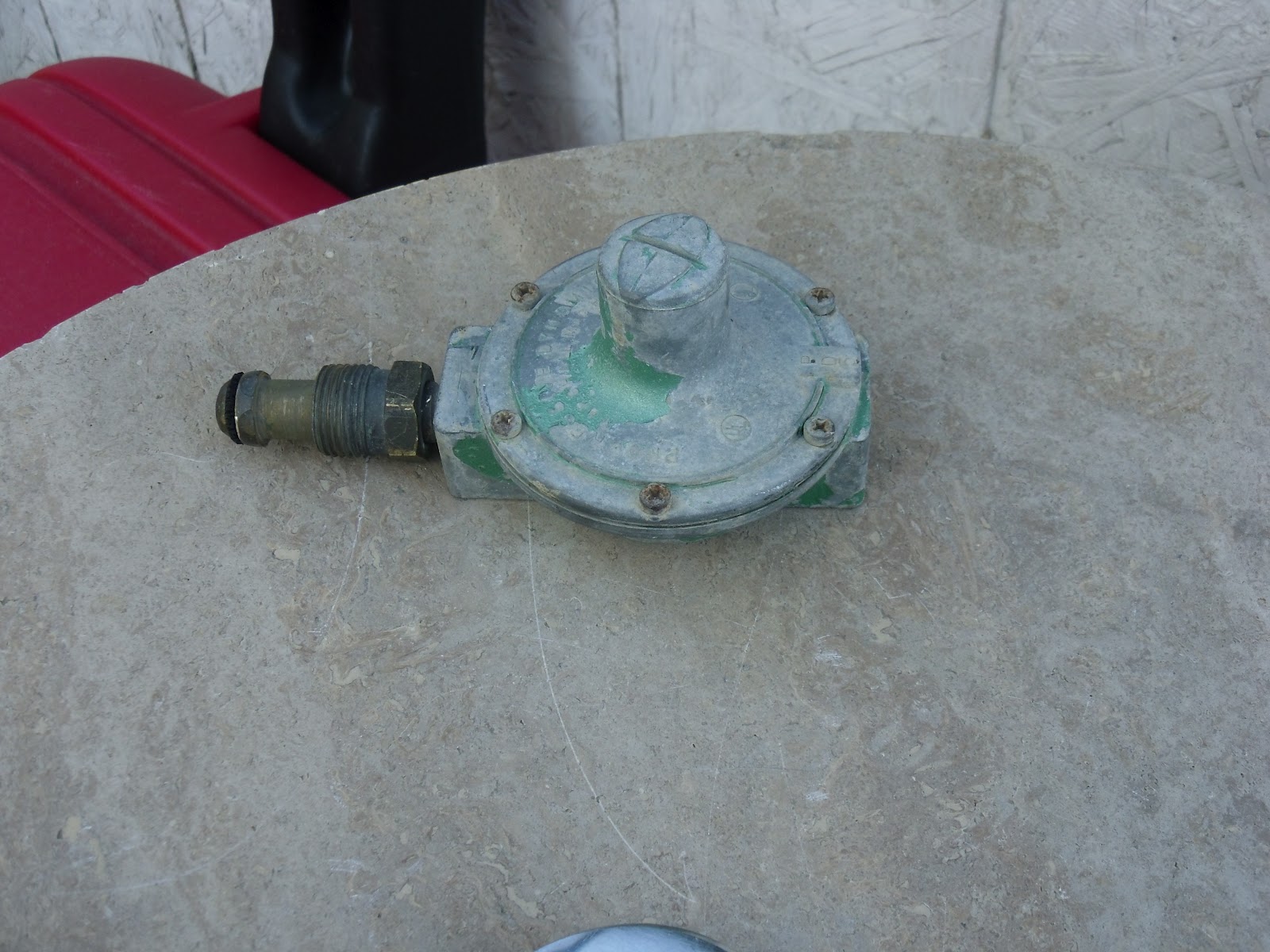
Now is the time of year where I start to do some trailer work.  When I have posted on my blog before about about work that I have done on my trailer, it has been popular.  I felt that I was not getting enough flow out of my propane system, especially on the propane light and knowing that the previous owner never used the propane system I figured that something was plugged in the system.  After a quick search on the Internet most people blame the regulator.  It is very possible that the regulator was clogged or damaged as I am sure that it had travelled a few miles without being plugged into a tank, and then being stored that way too, not to mention that the trailer is from the 70's so it is probably getting near the end of its useful life.  I decided that I would replace the regulator, and while I was at it upgrade the end of the hose to the new style so that I did not need to bring a crescent wrench down to the trailer when I wanted to change propane tanks. 

I know very little about gas fitting, other than standard plumbing rules.  I know that they use a different type of Teflon tape than with water.  The first thing I did was remove the old regulator to make sure that I got the right one from the store.  You could remove the nozzle too, but I wanted to change the style and I was not sure of the condition it either.  You cannot see it here, but the O-ring is pretty rough.


I put the old hose that connects to the steel lines on the new regulator.  Here you can also the new nozzle hose and some of the tools I used to get things apart and back together.  I would recommend a bench vise if you have access to one.


I taped all of the connections and made sure that they were very tight.  I reconnected the flex line to the steel lines.  Even though they are rusty they appear to be fairly strong and intact.


Once everything was connected I cracked open the propane tank and checked all of my connections for leaks.  I did not detect any leaks.  It was time for phase 2 of the testing.


I went inside and ran the propane on the stove, and I think the flow is better as I did not do a control test before I removed the regulator to see the flow.  When we bought the trailer there was an old propane light fixture, but the globe was damaged and I did not know what kind of mantle would go onto the light.  So I removed the light fixture and put a brass nipple and elbow and then a Primus fitting (the male fitting on a disposable propane bottle, or 1" x 20 TPI Male fitting) so that I could screw my camp light onto it.  When I put the light on I get a little bit of propane out of the light but there is still not enough flow to the light for it to burn.  I am going to have to experiment a little to find out what is regulating the flow down so that there is not enough propane.  


If you have any thoughts on this or your own propane stories, please share in the comments section.


Monday, April 30, 2012

Z is for Zero


Z is for Zero

In discussion with some colleagues at work on today’s topic on zero they said that I should have a bit where the limit of the function tends to zero.  Being that I generally do not discuss calculus on the blog generally and that limits are not my favourite thing to talk about I will defer that topic for the time being.

A zero is an important concept in building something. It is also known as a datum.  This is the point in which to measure everything off of, and therefore all cuts and work are from it.  I typically have two types of measurement errors, the first is where I just make a mistake and the second is where I take a measurement off of another cut without double checking to make sure the measurement chain works out.  Sometimes it is as simple as I did not account for the width of the blade in the cut.  Other times I was just not careful in the math to work out the chain.

On lumber typically the most accurate sides to take measurements off of are mill cuts or the factory cuts.  They are usually identified either with some paint or they have writing on them.  You know that the cuts are parallel and perpendicular to the work so that your other cuts have a chance at being so too. 

When machining you will take your metal stock and make a zero by facing off the stock so that it is also flat, parallel and perpendicular to the work surface.  From this surface all of the measurements are worked off from there. 

I have made these mistakes on my personal projects and whenever I get a drawing that has a dimension that comes from nowhere I tend to ask a lot of questions about it, or try to work through the measurement chain to see if the measurement is correct.

Please share some of your measurement adventures in the comments section below.  

If you like what you have read, please subscribe to the blog, or follow me on twitter at @bjshideler. Also, share this post with your friends on your favorite social media sites.

Wednesday, April 25, 2012

V is for Vehicle Maintenance


V is for Vehicle Maintenance

When I was about 13 years old my Dad said to me that because I was going to be driving soon, I needed to learn how to change the oil on the vehicles.  In Alberta Canada you can begin driving with a fully licensed driver as a learner when you are 14 years old.  At this point in time we only had 3 vehicles.  Dad had his truck, mom had hers and there was the farm truck.  This began my work on vehicle maintenance.  During the peak of my teen years there were 7 vehicles at the house for my sister, myself and my parents.  I had plenty of opportunity to work on them.  We did not have a fully equipped garage, but we had basic tools so we did basic work.  There was plenty of opportunity to change oil and other filters.  After high school I worked out of town and commuted at least 130km per day so I was changing oil every 5-6 weeks (5000km) and I got really fast at it too.  My friend was over one day and he had worked in lube shop and he was impressed at how quick I was able to change the oil in my car (less than 20 minutes). 

During high school I worked at both Home Hardware and NAPA Auto Parts and I learned that with older cars vehicle maintenance it is very important to do regular oil changes.  It is probably the single most important thing to do.  I found a number of additives that helped out with the performance of my car.  We sold and recommended the Lucas Oil line of products; they are what I use even to this day.  I put the fuel additive into my vehicle the other day and I got a 12% gain in fuel efficiency. 

We have just purchased an older vehicle for my wife (2001 PT Cruiser) and it has some basic work that needs to be done.  I am thankful that I am able and knowledgeable to perform that work rather than pay someone $120/hr to do it.  So soon we will change out some signal lights, change the oil, change the battery, and change the air filter and some other work.  When we get to that work I will take some photos and post on that process.

Share with group some of the maintenance that you do on your vehicles.

If you like what you have read, please subscribe to the blog, or follow me on twitter at @bjshideler. Also, share this post with your friends on your favorite social media sites.

Monday, April 23, 2012

T is for Tools

T is for Tools

Any time I begin a new project I like to go and get a new tool for it, which frustrates my wife to no end.  She does not like to spend money on things and she sees tools as a sunk cost with no added value to the project.  This is further aggravated if she does not really approve of the project in the first place. 

I however see tools as a good investment, by having tools I can perform more functions in the future if the need ever arises.  They also allow me to work faster and safer.  I have mentioned on previous posts of how this is the case.  For example on my post about my lawn mower that I was sharpening last year, I wasted a lot of time trying to get the snap ring off as well as I also almost puncture my hand several times with normal pliers before I got the proper tool. If you use the wrong tool for the job, there is a high likelihood that you will damage that tool by using it improperly. 

When I go and select a tool to buy I usually approach it from one of two perspectives.  Either I want that tool for repeated use and for a number of years or I have a one off tool for a specialty task that I do not perform very often.  For the first case I will spend the money and get a quality tool, now I do think you get what you pay for to a point.  I don't think the most expensive tool is necessarily better than one just above the middle of the pack.  If it is a one off tool then I will tend to get the cheapest tool to finish the job.

Share some of your stories about your tools below in the comments.

If you like what you have read, please subscribe to the blog, or follow me on twitter at @bjshideler. Also, share this post with your friends on your favorite social media sites.

Friday, April 20, 2012

R is for Renaissance Man

R is for Renaissance Man

I came across the term Renaissance Man a little while ago and I really like the term.  It means a person who has expertise in many fields spanning a wide range of topics.  There are a number of scientists and artists that are considered Renaissance men people like Leonardo da Vinci, Galileo, Michelangelo, Newton, Ben Franklin, and Thomas Jefferson. Now these men had to out of necessity become proficient in multiple fields so that they could progress their work forward as no singular discipline is isolated from another.  The term was popularized during the Renaissance period where it was socially expected to be well rounded in both the arts and sciences. 

Jack of all trades is a term that is similar in meaning but slightly different.  It is a step down the Renaissance man in that he may not have an expertise in the many fields, but be skilled or competent in many trade or practical fields versus in academics.  I tend to find myself between the two worlds.  As one that likes to work on projects of various natures and disciplines I find myself gaining competency in many areas.  I also have diverse academic interests.  I think striving to become a Renaissance man is a worthwhile goal, but I do not think that you can call yourself one, it is one of those titles that is best to be bestowed upon you by others. 

I find that there is a trend for people to be specialists rather than have a broad skill set.  It does make sense for some people to become very specialized and focus their talents upon one specific skill set, but for the majority of people out there in my opinion specialize on areas that limit their abilities if that skill set becomes obsolete.  Also, I find it limits people when the find themselves in diverse social settings as they have limited range of topics in which to discuss with people.  I am sure we have all been at a social gathering talking with someone and they are all into one particular topic (ie cars) and though I may know something on that topic I do not want to talk about it the whole time I am at that event unless that is what the event is about.  But after I get to the end of knowing all that I want to know about it I desperately want to move onto someone else so that I can change topics.

Share some of your thoughts on this topic.  Maybe share some stories of how you have been trapped by someone that just wants to discuss one topic or share a topic that you would like to know more about that is totally different than you currently do.

If you like what you have read, please subscribe to the blog, or follow me on twitter at @bjshideler. Also, share this post with your friends on your favorite social media sites.

Friday, April 6, 2012

F is for Finishing


F is for Finishing

One of my biggest struggles that I have is to finish the projects that I start. I am pretty sure that I am not the only one as there are plenty of home improvement rescue shows where they have to complete the plethora of unfinished tasks.  I am aware of this tendency that I have, so I am reluctant to start new projects before I complete other ones. 

I have been trying to identify why I do not finish projects up to completion.  I think the reason that I have is that I underestimate the time required to complete the project.  Typically I allocate 1 or 2 Saturdays to complete the project, as my Saturdays are precious and get booked up with lots of different commitments, so I need to get the project done in that time or else it will be several weeks before I can return to it, this is especially compounded if I need assistance to complete the project.

Another thing that I discovered when I was studying in university was that if I said that I was almost done on an assignment I would see how much time I had put in already and that was how much more time I had left to complete the project.  For example if I was doing a lab report and it had already taken me 8 hours to get to a point where I felt it was almost done it would take me another 8 hours to complete the rest of the lab report.  I had on my own discovered the Pareto principle.  The Pareto principle is also known as the 80-20 rule, which is where 80% of the results come from 20% of the work.  So I guess it is human nature to move on to next item when they see their effort as diminishing in returns. 

So if you have any suggestions on how to stay motivated until the end of the project, please share them in the comment section.  As always if you like what you have read, please subscribe to the blog, or follow me on twitter at @bjshidelerAlso, don't be afraid to share this with your friends on your favorite social media sites.

Wednesday, April 4, 2012

D is for DIY

D is for DIY

I lived in the northern England for a little while, and while I was there I had a roommate from southern England.  I had grown up on a farm, so I had no idea what DIY was, we just fixed it ourselves, rather than pay too many people to do it.  But when something was not quite right and I suggested that we just fix it, he got all excited that we were going to be doing some DIY.  He hadn’t done much DIY in his life and it was something that he always wanted to do. 

Sometimes I like to fix things myself especially mechanical devices because I get to see how they work and how they were put together.  As I completed my engineering degree I also see more of the engineering that was put into it like the motion and energy transfer and movements.

For determining whether or not I should fix something myself it usually comes down to one of two options.  Do I have the time to do it myself or do I have the money to get someone else to do it?  Part of the time calculation includes how much experience I have with it or how complicated the repair is, also do I have the tools to do the job efficiently. 

For example, if I something on the internals of my engine of my vehicle stopped working, then would likely get someone else to fix it as I have very little experience in successful engine repairs, in fact I the opposite.  I have tried to fix something on a quad I had in high school, but ended up having to take it to the repair centre because I messed something up.  On the other hand I had an alternator failure on my car and I was confident to be able to change that because it was just unbolting and unplugging it.

I feel fairly confident in most of my abilities on home based repairs, like stuff with wood, electrical and plumbing.  Due to my working in commercial construction I am concerned with making sure things meet code, so I will consult with contractors at work to make sure that I am doing things correctly.

Here is a quick note on tools.  Make sure that you have the correct ones.  My wife gets upset whenever I have a new project to take on that I want to buy a new tool.  Well, for me if the new tool will make it so that I can complete the job quicker and safer, then I am all for it.  I will admit sometimes the tool is for a status symbol, but that is not typically the only reason for the purchase. 

If the costs for you to do the job based on a virtual discounted rate compared to having a professional to do the job, and you have the desire to learn how to do the work by doing it yourself, then by all means embark on the exciting journey of DIY.  If you don't know how to do something google it and find a forum and watch plenty of YouTube videos.

If you like what you have read, please subscribe to the blog, or follow me on twitter at @bjshidelerAlso, don't be afraid to share this with your friends on your favorite social media sites.

Sunday, January 22, 2012

Plugs and Switches

Here is a post that I should have done a while back but never got around to writing.  When we moved into the house almost a year ago all of the plugs and swiches were the original cream colored switches from the early '80s.  The twist was that the cover plates had been changed to  white covers.  This looked quite tacky.  Also, after talking with my colleague who is an electrical engineer he said that the rough lifespan of the outlets is about 20 to 25 years. It was about time to change the outlets.  We were fortunate enough that the wiring in the house was copper wires.  It was common practice in the '70s in Alberta to use Aluminum wiring.

I had never changed a plug before, but on standard wiring there is two insulated wires which go to the two terminals and then there is the bare copper ground.which has a green terminal.  I was not too worried about it, considering A/C power is more forgiving than D/C. 


I had a plug tester, so after I turned the breaker I pulled the plug out.  I came to find that the wires on the original plugs were inserted into the holes of the plugs rather than using the screw terminals.  From my research this was also common during the 70s and 80s.  The problem with doing it that way is that the connection is spring held and over time the spring can fatigue and fail leaving a potentially dangerous situation.

The install was pretty simple, I cut the wires off the plugs and stripped them so that I could use the screw terminals.  We upgraded the plugs to use the Decora plugs and both the plug and the cover will be matching white. 


The switches were pretty much the same story except for the 3 way switches.  3 way switches have an extra terminal.  Because this is an existing house I couldn't tell which were the Travellers and which was the Common Wire.  Below is a diagram showing the circuit of how it works.  If you are building a new house it might be a good idea to label the wires in the box for people in the future or at least to follow some convention of what color wire to use.


 Just remember to respect electricity and beware of the path to ground and make sure that you are not apart of it.  Also, do not be afraid of electrical work as you are basically creating a circle with it.

If you like what you see here on the blog, then you should subscribe to it so that you get all of the updates when they come out.   Also, if I have missed anything or if you have anything to add then leave a comment.

Tuesday, December 13, 2011

Titan DX Antenna Install

I have recently received my Titan DX antenna from GAP Antenna.  As I was intending to mount it on a tripod mount on top of the roof of the house I also got the guy kit.  One note on the guy kit is that there are no anchors included with it.  As I am not experienced with HF antennas it took me a bit to figure out how to put the antenna together, and from everyone that I read online it does take a long time to assemble.  So the first day I got it put together, and mounted on the tripod.  On the second day I got the counterpoise installed and connected the end for the coax and attached the feed line. 

They don't mention anywhere in their documentation what the coax was and it is a house brand with no labels, so I called them and inquired.  GAP uses a RG-8X equivalent.  I needed this information because they had a male UHF (PL-259) to go on the antenna, and I had a connector for a male 259 to go on the feed line coax.  Also in my tool box I have a handful of male N connectors.  So I went down to MRO Electronics in Calgary and got a female N connector to go on the coax.  For those that are not as up to speed on coax a RG-8 and RG-8X are not similar at all.

As I assembled the antenna with the self tapping screws provided, I understand why several people have recommended changing the screws out for machine screws with lock nuts.  As Winter was nearing in Calgary and I did not have many days without snow on the roof I needed this to get done and put that off to a future day.

I was unable to get the grounding installed for the antenna, so that will be a spring project before the lightning comes.  Other than that I just need to poke a hole into the house, do some testing and get on the air. 

Below is some pictures of the build.

 The middle section where the coax attaches to the antenna.

Looking from the "top" down the length of the antenna.

A closer look at the center section


The base where the counterpoise will mount

The top covered with a dust cap and a capacitor just inside.

Push lawnmower

Here is a quick project that I did quickly in early June that never got published until now.  With the purchase of our home this winter I got my small patch of grass, and to be the good neighbor I should mow that lawn.  As outdoor storage space is limited, and the area of grass is small we decided to purchase a reel lawnmower.  I found a Gardena 380C on Kijiji and purchased it.  It had been used for a couple of seasons and I had noticed the blade was dull when I purchased it.


I tried it out on the lawn that was very lush and it seemed more like I was flailing my lawn into submission rather than cutting it and it took about 1.5 hours to do our little patch of grass.  I began to look for a sharpening kit.  They are not very common, but I did find a sharpening kit at Canadian Tire. 


This kit is more accurately called a honing kit.  First you take the wheels off because you will use the wheel to turn the blade against the back bar and sharpen the blades.  I tried getting the wheels off and it was nearly impossible due to the snap rings holding them in place.  So instead of injuring myself, which I came close to doing I went and acquired some snap ring pliers also from Canadian Tire.


Once I got the wheels off and applied the honing compound to the reels I noticed that there was a large gap between the reel and the back bar.  I adjusted the bar to be closer to the reel.  Be careful not to make contact as it will dent the bar and leave a rough bur edge that will knock on the reels.  Following the remaining instructions and putting the mower back together was real easy.  Now my mowing time is about 20 minutes depending on the amount of growth during the week.